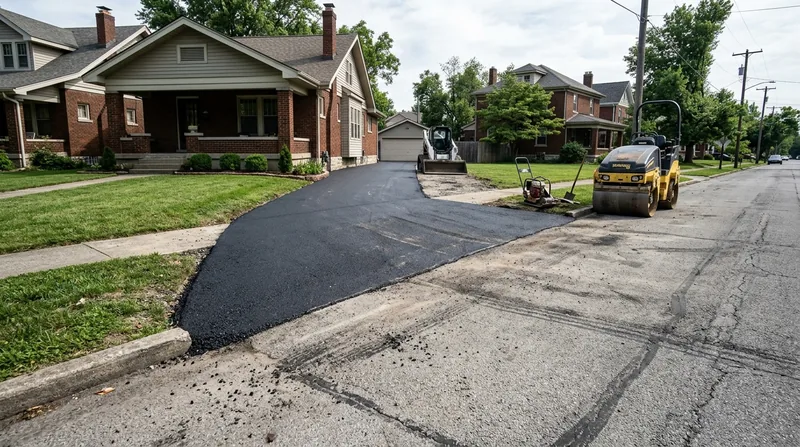




Louisville's older neighborhoods, from Old Louisville and Germantown to Schnitzelburg and the Highlands, sit on narrow lots where driveways run as long thin side strips from street to garage. In the rolling post-war suburbs and newer subdivisions spreading into Jefferson and Bullitt counties, those same drives pitch with the grade. A driveway extension, widening, or apron in Louisville needs to tie seamlessly into the existing surface without a seam that opens by the first spring thaw. We cut a clean butt joint, match the grade, and compact new hot mix asphalt so it holds through Kentucky's real freeze-thaw cycles. Whether you need to widen a cramped drive for a second car, extend it to reach a new garage, or pour a proper apron at the street to stop gravel washing into the storm drain, the work is the same: clean prep, matched elevation, and compaction that lasts.
Why Driveway Extensions and Aprons Matter in Louisville's Climate
The clay, silt, and sand weathered from limestone and shale bedrock beneath Louisville holds moisture and moves as it wets and dries. A driveway extension or apron that is not pitched properly or sits on a poor base becomes a dam, trapping water at the joint where new meets old. That trapped water freezes in winter, thaws in spring, and opens a crack wide enough to drive a truck through by April. An apron that slopes toward the street instead of away from it channels runoff straight into the foundation. A widening that is not compacted to the same density as the original drive settles unevenly and cracks along the seam within a year.
- A poorly compacted new section settles at a different rate than the original driveway, opening a seam by the first winter.
- Water trapped at the joint between old and new asphalt freezes and thaws, pushing the seam open and creating a pothole by spring.
- An apron pitched the wrong way channels water toward the house instead of away, causing foundation and drainage problems.
- A clean butt joint cut square to the existing surface prevents water from pooling along the edge and seeping underneath.
The difference between a driveway extension that holds for years and one that fails by spring is the compaction, the grade, and the joint itself.
Key info: Louisville's freeze-thaw cycles are relentless. A driveway extension in Jeffersontown or Prospect that is not compacted to the same density as the existing drive will settle unevenly and crack along the seam within twelve months. We match compaction and grade to prevent that failure.
For more on how Louisville's climate shapes asphalt maintenance, see our guide to driveway repair and the role of proper base preparation in preventing seasonal damage. The Louisville Metro Department of Public Works sets permitting rules for curb cuts and right-of-way work, so verify with your city whether your extension needs a permit before we begin.
How We Build Driveway Extensions, Widening, and Aprons in Louisville
The work starts with a site visit to understand the existing drive's pitch, the base condition, and where water needs to go. We measure the extension or widening, cut a clean butt joint into the existing asphalt, and prepare the base underneath. If the base is soft or settling, we add crushed stone and compact it. We then lay hot mix asphalt at the same temperature and compaction as the original drive, so the new section bonds to the old one and settles at the same rate.
- We inspect the existing driveway to understand its pitch, base condition, and drainage pattern before we plan the extension.
- We cut a clean square butt joint into the existing asphalt, removing any loose material or debris at the edge.
- We excavate and prepare the base, adding compacted crushed stone if the soil is soft or the grade is uneven.
- We lay hot mix asphalt at the same temperature and compaction density as the original drive to ensure they bond and settle together.
- We proof-roll the new section with a vibratory roller to confirm compaction before traffic is allowed.
The result is a seamless extension or apron that handles Kentucky winters without opening a seam or settling unevenly.
Local example: A homeowner in Middletown wanted to widen her driveway to fit two cars side by side. The original drive was pitched to the right to shed water away from the house. We matched that pitch on the new section, cut a clean butt joint, and compacted the new asphalt to the same density as the old. Two years later, the seam is tight and the widening has settled at the same rate as the original drive.
For details on how we handle base preparation and grading in Louisville's rolling terrain, see our page on gravel driveway installation and grading. If your existing driveway needs repair before we extend it, we can assess that on the same visit.
Methods and Approaches for Driveway Extensions, Widening, and Aprons
| Approach | Description | Best For |
|---|---|---|
| Hot Mix Extension | New asphalt laid at 300+ degrees and compacted to match the existing drive's density and pitch. | Seamless widening, lengthening, or aprons where the new section must bond to the old and handle freeze-thaw cycles. |
| Base Preparation and Compaction | Excavation, crushed stone base, and vibratory compaction to match the existing drive's foundation. | Extensions on soft soil, uneven grades, or where the original drive's base is unknown and must be matched. |
| Apron Installation | A small asphalt pad at the street or property line, pitched to shed water away from the house and stop gravel from washing into the storm drain. | Transition zones at the street, curb cuts, or where gravel drives meet the paved drive. |
| Recycled Asphalt Millings Extension | Compacted recycled asphalt millings as a budget alternative for non-critical extensions or temporary widening. | Gravel pads, temporary parking areas, or budget-conscious extensions where freeze-thaw durability is not the first concern. |
Each method is chosen based on the existing driveway's condition, the grade, the soil, and how long you expect the extension to last. A hot mix extension into a high-traffic area lasts 15 to 20 years if compacted properly. A recycled millings extension is a lower-cost option for low-traffic or temporary areas, but will need raking and re-compacting every few years.
Driveway Extensions, Widening and Aprons Cost in Louisville: What to Expect
A driveway extension or widening in Louisville starts at around $1,800 for a small pad or a short extension on a prepared base. The cost moves up with the length of the extension, the width you need, the condition of the base underneath, and whether we need to excavate and add crushed stone. An apron at the street, 8 to 10 feet wide and 4 to 6 feet deep, typically runs $1,200 to $2,500 depending on the site. A full-width widening of a 12-foot driveway to 16 feet for 30 feet of length can run $3,500 to $5,500, again depending on base work. If the existing base is soft or uneven, or if grading is steep, the base prep costs more and the total rises.
The single biggest variable is whether we need to excavate, remove old material, and lay a new crushed stone base or whether the existing base is sound and we can simply extend on top of it. A site visit lets us see the base, measure the job, and give you a firm estimate with tonnage and specifications. Get two or three estimates so you can compare compaction standards, base prep, and the thickness of the asphalt being laid. A firm estimate should list the tonnage of asphalt, the depth of the base, and the compaction method.
For a full breakdown of pricing across all our services and what factors move the cost up or down, see our pricing page. Call us at (502) 754-0671 for a free estimate on your specific job, and we will give you a written quote with tonnage and compaction specs before any work begins.
Driveway Extensions, Widening and Aprons Near Me: What Louisville Homeowners Should Know When Hiring
When you are looking for someone to extend or widen your driveway in Louisville, Prospect, Jeffersontown, or anywhere in Greater Louisville, ask the right questions before you sign anything. Find out whether the contractor is fully insured and can provide proof of coverage. Ask for references from recent jobs in your area, and follow up by calling them. Ask to see a written estimate that includes the tonnage of asphalt, the depth of the base, the compaction method, and the total cost. Understand whether your city requires a permit for the work, and if so, confirm that the contractor will help you navigate the permitting process. If you are in an HOA community, check your architectural standards to make sure an extension or widening is allowed and what material is required.
Be wary of unsolicited door-to-door offers, prices that seem too good to be true, requests for large cash deposits upfront, or contractors with out-of-state plates. The strongest trust signal in this trade is a local address, local plates, and a willingness to put the job details in writing. Louisville and the surrounding areas have a long history of itinerant crews offering cut-rate paving with no written contract and no follow-up when the work fails. You can verify any contractor's insurance status by asking for a certificate of insurance. You can ask the Louisville Metro Department of Public Works or your city's building department whether permits are required for your specific job. You can call the references and ask whether the work is holding up and whether the crew showed up on time and cleaned up after themselves.
Louisville Asphalt Paving has been in business since 2016 and serves Louisville, St. Matthews, Jeffersontown, Shively, Middletown, Prospect, and surrounding communities. We provide written estimates with tonnage and compaction specifications, and we are fully insured. Contact us for a free estimate on your driveway extension, widening, or apron, and we will walk you through the process and answer any questions about permits, HOA requirements, or base preparation.
Driveway Extensions, Widening & Aprons in Louisville: Pricing Guide
| Service | Price | Details |
|---|---|---|
| Small apron or short extension | Starting at $1,800 | 4 to 6 feet wide, 8 to 10 feet long, on a prepared base with minimal excavation required |
| Full-width driveway widening | Starting at $3,500 | Extending an existing 12-foot drive to 16 feet for 20 to 30 feet of length, including base prep and compaction |
| Driveway extension or lengthening | Starting at $2,500 | Extending an existing drive 15 to 20 feet in length at the same width, including base preparation and matched compaction |
| Complex job with excavation or grading | On estimate | Soft or uneven base, steep grade, or extensive excavation requires a site visit to measure and calculate tonnage |
| Free estimate | No obligation | Written quote with tonnage, base depth, and compaction specs, response within 24 hours at (502) 754-0671 |
Indicative pricing, the exact cost depends on square footage, finish, and site access. Free personalized estimate within 24h at (502) 754-0671.


