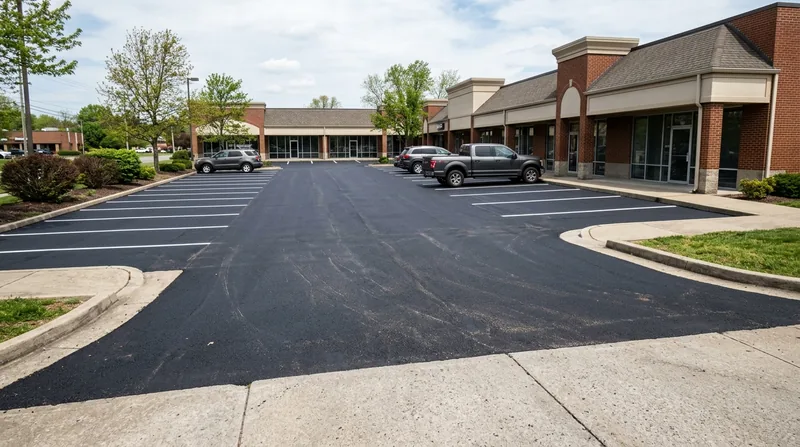




Parking Lot Paving & Construction in Louisville means building a surface that stands up to clay movement, heavy daily traffic, and the freeze-thaw cycles that crack and pothole commercial lots every spring. Louisville's commercial properties sit on ground weathered from limestone and shale, where moisture moves through the soil as seasons change, and that movement breaks any surface not built on a solid, properly pitched base. A parking lot that sheds water and rests on compacted aggregate will last. One that holds water or sits on poor fill will fail in three to five years, no matter how thick the asphalt on top. We grade, compact, and pave in binder and surface courses, with drainage set for Louisville's heavy spring rains and the hot, humid summers that soften a weak base. The work starts before the asphalt goes down.
Why Parking Lot Paving & Construction Matters in Louisville
A commercial lot across Jefferson County lives or dies on its base. The clay, silt, and sand beneath Louisville move as they wet and dry, and that movement heaves and cracks any asphalt laid over poor drainage or uncompacted fill. Spring rains push water into the subgrade, summer heat softens it, and by fall you see alligator cracking and potholes. A lot built right stays flat and drains fast. A lot built cheap fails in half the time and costs twice as much to fix.
- We excavate and grade to the site's natural slope, then compact the base in lifts to remove air and lock the material together.
- We install drainage swales or underdrains where the site holds water, so rain moves off and through, not into the asphalt.
- We lay binder course asphalt for stability, then surface course for wear, both compacted to density so the lot stays smooth under heavy traffic.
- We pitch the surface to catch and shed water, because standing water is the enemy of any parking lot in Louisville.
A lot built this way will serve a commercial property for 12 to 15 years before resurfacing becomes the smart move.
Key info: Louisville's building department and the city's stormwater rules set the grade, the pitch, and the impervious-surface limits for any new lot. Permits are required, and the rules vary from one jurisdiction to the next across Jefferson County. We help you navigate the requirements, but you must verify with your city or village before we stake the job. See the City of Louisville website for local codes and permitting.
How We Build a Parking Lot in Louisville: The Process from Grade to Finish
A parking lot starts on the ground, not on top of it. We survey the site, mark the utilities with Kentucky 811, and then excavate to the depth the design calls for. The base is the whole story. We compact it in layers, test it with proof rolling to make sure it will hold traffic, and pitch it so water runs off. Then we pave in two courses, binder first for strength, surface second for wear. Every step is measured and documented.
- We call Kentucky 811 for utility locates before any excavation, because hitting a line stops the job and costs money.
- We excavate to the base depth, remove unsuitable material, and haul it off or stockpile it for later use.
- We place and compact new aggregate base in four to six inch lifts, testing density with a nuclear gauge or sand cone to verify compaction.
- We install drainage infrastructure (swales, underdrains, or catch basins) so the lot sheds water instead of holding it.
- We lay binder course asphalt at the temperature and thickness the design specifies, then compact it with a roller.
- We lay surface course asphalt, compact it, and stripe the lot with paint and thermoplastic markings.
The whole sequence takes two to four weeks depending on the lot size, weather, and the depth of base work required.
Example: A 15,000 square foot lot in St. Matthews with a high water table required four feet of excavation, removal of clay, placement of compacted stone base, and a perimeter underdrain. The lot now drains in two hours after heavy rain. Without that base work, it would have puddled and cracked within two years.
See our page on Private Road & HOA Paving for similar construction on private roads and subdivision entrances.
Parking Lot Construction Methods and Approaches
| Approach | Description | Best for |
|---|---|---|
| Full Depth Reconstruction | Excavate to subgrade, remove old material, install new compacted base, and pave with binder and surface courses. | New lots, lots with failed base, or sites where drainage must be completely rebuilt. |
| Mill and Overlay | Remove the top two inches of existing asphalt, recycle it, and lay a new surface course over the existing base. | Lots with sound base and surface wear only, when budget is tight and the base is not moving. |
| Full Overlay | Leave the existing lot in place and lay a new two to three inch binder and surface course over it. | Lots with good base and moderate cracking, when full excavation is not feasible or permitted. |
| Patching and Seal | Fill potholes and failed areas with asphalt, compact them, and leave the rest of the lot as is. | Temporary fixes on lots scheduled for resurfacing or overlay within one to two years. |
| Recycled Asphalt Base Layer | Use reclaimed asphalt millings as a base or subbase layer, compacted and proof-rolled before new asphalt overlay. | Budget-conscious lots where a recycled material meets code and the site allows it. |
Each method has a cost and a lifespan. Full reconstruction is the longest-lasting but the most expensive. Mill and overlay is the fastest and cheapest if the base is sound. We recommend the approach that fits the lot's condition and your budget.
Parking Lot Paving & Construction Cost in Louisville: What to Expect
The cost of a parking lot depends on the lot size, the condition of the existing base, drainage requirements, and the depth of excavation needed. A new lot on prepared ground will cost less per square foot than a lot that needs the base rebuilt because the subgrade is failing or water-logged. Louisville's clay soils and freeze-thaw winters often mean deeper base work than you would need in a drier climate, and that work is where the cost lives.
We provide a free commercial estimate on site, with tonnage specs and a written breakdown. The estimate includes a site visit, measurement, and a proposal that tells you what we will do, how much material goes in, and what the finish will be. We respond within 24 hours at (502) 754-0671. From there, the cost depends on:
- Lot size and the square footage of asphalt to be placed or replaced.
- Base depth and the amount of excavation, fill, and compaction required.
- Drainage infrastructure, including swales, underdrains, or catch basin installation.
- Existing surface condition, whether you are patching, overlaying, or doing full reconstruction.
- Site access and the distance from the lot to the asphalt plant, which affects delivery cost.
A typical small commercial lot (5,000 to 10,000 square feet) with a sound base and needing a mill and overlay will run from $15,000 to $25,000. A new lot with full base construction can run $30,000 to $50,000 or more, depending on excavation depth and drainage needs. The only way to know your lot's cost is to get it measured and quoted. See our pricing page for a more detailed breakdown and call us for a free estimate.
Parking Lot Paving & Construction Near Me: What to Look For When Hiring a Louisville Contractor
A parking lot is a capital asset. The contractor you hire will determine whether it lasts 15 years or fails in five. The strongest signal that a contractor is local and trustworthy is a local address, local phone number, and a local reputation. The itinerant crew that shows up with out-of-state plates and an offer to use "leftover asphalt from a job nearby" is the classic paving scam. Honest contractors are based here, they stand behind their work, and they can be reached if something goes wrong.
When you are comparing contractors, ask for and check these things:
- A written estimate that includes lot size, base depth, material tonnage, and the thickness and type of asphalt to be placed.
- References from other commercial properties in Louisville or the surrounding area, and call them to ask how the lot has held up.
- Proof of insurance, because the contractor must carry general liability and property damage coverage if something goes wrong on your lot.
- Clarity on permits, because your city or village may require a permit before work starts, and the contractor should know your local rules.
- A timeline and a description of how the work will affect your tenants or customers during construction.
Get at least two or three estimates before you decide. The lowest price is often a sign that something is being cut, usually the base work or the compaction. A realistic estimate will be detailed, will explain why the cost is what it is, and will give you a chance to ask questions. Contact us at our contact page or call (502) 754-0671 for a free estimate and to ask any questions about your lot.
Parking Lot Paving & Construction in Louisville: Pricing Guide
| Service | Price | Details |
|---|---|---|
| Free commercial estimate | No charge | On-site measurement, tonnage specs, written proposal with breakdown, response within 24 hours |
| Mill and overlay (sound base) | Starting at $1.50 to $2.50 per sq ft | Removal of top two inches, recycling, new surface course, compaction, striping included |
| Full reconstruction (new base required) | Starting at $3.00 to $5.00 per sq ft | Excavation, base compaction, binder and surface courses, drainage, striping, site-specific factors |
| Patching and spot repair | Starting at $500 to $1,500 per pothole | Pothole removal, base repair if needed, asphalt filling, compaction, temporary or bridge solution |
| Recycled asphalt base layer | Starting at $0.75 to $1.25 per sq ft | Reclaimed asphalt millings, compaction, proof rolling, preparation for overlay or new surface |
| Travel | Included | No separate mileage or call-out fee within Louisville and surrounding Jefferson County areas |
Indicative pricing, the exact cost depends on square footage, finish, and site access. Free personalized estimate within 24h at (502) 754-0671.


