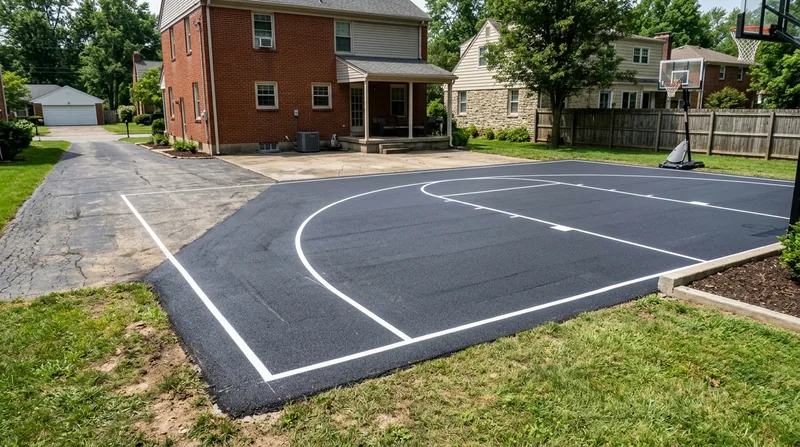




Sports Court & Path Paving in Louisville requires more than just laying asphalt. Louisville's clay-based soil moves constantly as it wets and dries through our freeze-thaw winters and humid summers, which means a basketball court, tennis court, or walking path built on a weak base will crack, settle, and fail within a few seasons. We build a stable aggregate foundation, pitch it for drainage, and lay hot mix asphalt suited to the heavy daily use and weather stress these surfaces endure. Whether you're a school, a park district, a community center, or a private property owner in Louisville or the surrounding areas like St. Matthews, Jeffersontown, or Shively, a properly built court or path is an investment that lasts.
Why Sports Court & Path Paving Matters in Louisville's Climate
Louisville sits on river-bottom clay and silt that expands when wet and shrinks when dry. A tennis or basketball court built directly on this soil, or on a thin, poorly compacted base, will heave in winter and settle in summer, opening cracks that let water in and accelerate failure. The freeze-thaw cycle that dominates Louisville winters pushes water into any gap and then forces it back out as a pothole or a crater by spring. Hard-use surfaces like sports courts see foot traffic, equipment wheels, and seasonal expansion stresses that demand a stable base, proper drainage, and quality asphalt laid to specification.
- We excavate and compact a crushed stone base thick enough to handle the soil movement and distribute loads evenly across the weak clay beneath.
- We pitch the court or path to shed water away from the playing surface and toward drainage swales or storm drains.
- We lay hot mix asphalt formulated for hard use, with the binder and aggregate selected for flexibility and durability in Louisville's temperature swings.
- We proof-roll the base to confirm compaction before any asphalt goes down, so you don't pay for a court that settles a year from now.
A court or path built this way will serve reliably for 15 to 20 years, depending on use and maintenance. Cutting corners on the base is the single most common cause of premature failure. For more on how base preparation affects all our asphalt work, see our gravel driveway and grading service page.
Key info: Louisville's freeze-thaw cycle is the real enemy of sports courts. A court built over clay with no proper base will crack by the second winter. The base is where your money goes, not the thickness of asphalt on top.
For guidance on local permits and site requirements, check with your city or county building department. Louisville Metro and many surrounding villages (Anchorage, Douglass Hills, Prospect) have specific rules on drainage, surface impervious limits, and utility location before excavation. We help you navigate those rules.
How We Build a Sports Court or Path in Louisville
Our process starts with a site visit and a clear understanding of the court's use, the soil conditions, and the drainage slope. We measure the area, assess the existing ground, and develop a plan for base depth, material, and pitch. Louisville's older neighborhoods (Old Louisville, Germantown, the Highlands) often have tight spaces and mature trees nearby, which constrains access and requires careful grading. Newer subdivisions in Middletown, Prospect, and Bullitt County sit on rolling terrain, so we grade the base to follow the natural slope while maintaining the court's playable flatness. Every job gets a written estimate with tonnage, thickness, and timeline.
- We locate all underground utilities (Kentucky 811 is required by law before any excavation).
- We excavate to the depth specified for the base, remove unsuitable material, and haul it off.
- We lay and compact crushed stone base in lifts, proof-rolling each lift to ensure uniform density.
- We set grades and slopes so water runs off the court, not into it, and toward storm drains or swales.
- We lay hot mix asphalt in two lifts (base and wearing course), compacting each to specification before it cools.
- We allow the surface to cure for 24 to 48 hours before opening it to foot traffic or light equipment.
The entire process typically takes 5 to 10 working days, depending on weather and site size. We coordinate with your schedule and keep you informed at every stage.
Example: A school in Jeffersontown needed a new basketball court in a side yard bordered by mature oaks and a storm drain. We located the utilities, excavated 6 inches to remove old asphalt and clay, set a 4-inch compacted base sloped toward the drain, and laid 2 inches of hot mix in two lifts. The court was ready for use 48 hours after the final rolling. See our asphalt driveway paving page for more on our approach to proper installation.
Methods and Materials for Sports Court & Path Paving
| Approach | Description | Best for |
|---|---|---|
| New court on prepared base | Excavate to grade, lay 4 to 6 inches of compacted crushed stone, proof-roll, then lay 2 to 3 inches of hot mix asphalt in two lifts. | Schools, parks, new community facilities, or property owners building a court from scratch on clay or weak soil. |
| Overlay on existing asphalt | Mill or scarify the old surface, lay 1.5 to 2 inches of new hot mix, and compact. Works only if the base is still sound. | Courts that are cracked but not heaving, and whose base has not failed. Faster and cheaper than full replacement. |
| Full-depth replacement | Remove all asphalt and base material, excavate to grade, rebuild the base, and lay new asphalt. Most thorough solution. | Courts with failed bases, severe heaving, or poor drainage. Guarantees a fresh start and many more years of service. |
| Tar and chip surface | Lay a binder course of liquid asphalt and cover it with aggregate chips. Lower cost but less durable than hot mix. | Walking paths, low-traffic recreational courts, or rural properties where a softer surface is acceptable. |
Each method has trade-offs. A new court on a proper base costs more upfront but lasts 15 to 20 years. An overlay is faster and cheaper but only works if the base is still sound. We assess your court on site and recommend the method that gives you the best value.
Sports Court & Path Paving Cost in Louisville: What to Expect
A new basketball or tennis court in Louisville typically starts at $8,500 for a small single court (about 2,500 square feet) with a properly compacted base and two lifts of hot mix asphalt. The price moves up based on several concrete factors: the size of the court or path, the depth and quality of the base required (clay soil needs more base than stable ground), the complexity of drainage and grading, access constraints, and whether utilities need to be located or moved. A larger court (3,500 to 4,000 square feet) or one that requires extensive grading or drainage work may run $12,000 to $18,000 or more. A walking path is typically cheaper per square foot because it carries less structural demand, but the base still matters just as much.
The single best way to know your actual cost is to get a written estimate on site. We measure, assess the soil and drainage, and give you a firm price with tonnage and thickness spelled out. We recommend getting 2 or 3 estimates so you can compare scope and value. For detailed pricing guidance across all our services, visit our pricing page.
Do not accept an estimate without a thickness specification or a tonnage figure. That's how you spot a contractor who is cutting corners or who doesn't know the job.
Sports Court & Path Paving Near Me: What Louisville Homeowners and Facility Managers Should Know
Hiring the right contractor for a sports court or path is critical because the base work is invisible once the asphalt is down. You cannot inspect it later, so you must trust the contractor to do it right the first time. Start by checking that any contractor you consider is fully insured and can show you a current certificate. Ask for references from recent court or path jobs in Louisville or the surrounding areas (St. Matthews, Jeffersontown, Shively, Prospect, Middletown). Call at least two of those references and ask whether the court has held up, whether the contractor was on time and professional, and whether there were any surprises in cost or scope.
- Verify that the contractor pulls permits if your city requires them (Louisville Metro and many villages do, depending on the site and the scope).
- Ask whether the contractor locates utilities before excavation (Kentucky law requires it, and hitting a line is costly and dangerous).
- Request a written estimate that includes base depth, asphalt thickness, tonnage, compaction method, and timeline.
- Confirm that the contractor has experience with Louisville's clay soil and freeze-thaw conditions.
- If you are in a master-planned community or an HOA, check the architectural standards for surface material and color before you commit.
Avoid any contractor who shows up unsolicited, offers a price on the spot without measuring, asks for a large cash deposit, or rushes you into a contract. Get everything in writing and ask questions until you understand what you are paying for. Contact us for a free, no-obligation estimate. We measure on site, explain the work clearly, and give you a firm price before you decide.
Maintenance and Long-Term Care for Your Court or Path
A new asphalt court or path must not be sealed for the first 6 to 12 months while the asphalt cures and hardens. After that window, periodic cleaning and routine maintenance will extend its life. Sweep debris off regularly, fill any small cracks as soon as they appear, and keep drainage clear so water doesn't pool. In Louisville's climate, cracks tend to open in early spring as the freeze-thaw cycle ends, so inspect your court in March and April and address any damage before it spreads. Proper maintenance can add 5 or more years to the life of a court.
When cracks do appear, address them early. A small crack sealed promptly costs $50 to $200. Ignored, it becomes a pothole or a section failure that costs thousands to repair. We can help with crack repair and maintenance. Call us at (502) 754-0671 to discuss your court's condition.
Sports Court & Path Paving in Louisville: Pricing Guide
| Service | Price | Details |
|---|---|---|
| Small court or path (up to 2,500 sq ft) | Starting at $8,500 | Includes excavation, 4 to 6 inch compacted base, 2 inch hot mix asphalt in two lifts, grading and drainage setup |
| Medium court (2,500 to 4,000 sq ft) | Starting at $12,000 | Larger footprint, more complex grading or drainage, or difficult soil conditions increase material and labor costs |
| Large court or multiple courts | On estimate | Site assessment required to determine base depth, drainage complexity, utility location, and access constraints |
| Overlay on existing asphalt | Starting at $4,500 | Resurface only, no excavation needed, works only if base is sound and not heaving or settling |
| Travel and site visit | Included | No mileage fee or call-out charge in Louisville and surrounding areas; estimate is free and no obligation |
Indicative pricing, the exact cost depends on square footage, finish, and site access. Free personalized estimate within 24h at (502) 754-0671.


