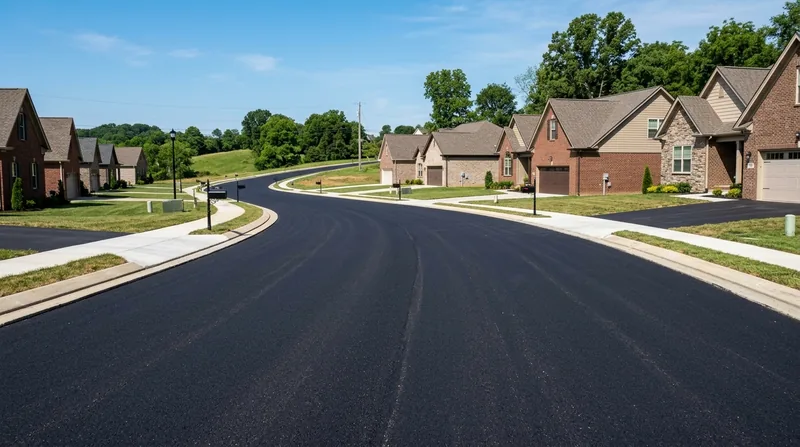




Private Road & HOA Paving in Louisville means building asphalt that survives the freeze-thaw cycle, clay movement, and shared traffic that define the subdivisions spreading through Oldham, Bullitt and Jefferson counties. Unlike a residential driveway, a private road carries multiple owners, heavier use, and drainage that affects neighbors downslope. The rolling terrain here, the moisture that moves through our limestone and shale bedrock, and winters that drive water into every crack make base preparation and pitch the difference between a road that holds and one that fails in five years. Louisville Asphalt Paving has built and repaired private roads and HOA driveways since 2016, and we coordinate the base work, binder and surface courses, and drainage so the whole road holds up together. We provide written estimates with tonnage specs so your HOA board knows exactly what it is buying.
Why Private Road & HOA Paving Matters in Louisville's Subdivisions
A private road through a subdivision in Prospect, Douglass Hills, or Middletown is a shared asset with shared liability. When the base fails under freeze-thaw stress or clay heave, the whole neighborhood pays. When drainage is wrong, water pools in the center and pushes into the surrounding lots. When the asphalt is thin or poorly compacted, potholing starts in year two and spreads fast across a road that sees delivery trucks, school buses, and daily commuter traffic. The cost of a patch here, a pothole there, and finally a full replacement is far higher than doing it right once.
- A proper base is built to move with clay and shed water, not just sit on top of the ground.
- The asphalt is pitched to shed water so rain runs off into the shoulders and swales, not into cracks.
- Binder and surface courses are laid in sequence so the road bonds together and resists both traffic and weather.
- Drainage swales or pipes are graded so water does not pond in the roadbed or at the toe of the slope.
- The work is coordinated with your HOA so the road meets architectural standards and local permit rules.
A well-built private road holds for fifteen to twenty years with routine crack filling and no seal coat. A poorly built one fails in half that time and costs twice as much to fix.
Local example: An HOA in St. Matthews paved a private road without a proper base in 2010. By 2016, alligator cracking covered thirty percent of the surface. A full replacement cost nearly triple what a correct base and overlay would have cost in year one. Kentucky cities including Louisville require that new private roads meet drainage and compaction standards before final acceptance. Verify your local building department and HOA architectural rules before starting work.
For more on how base preparation affects all asphalt paving, see our Asphalt Resurfacing & Overlay page.
How We Build Private Roads and HOA Driveways in Louisville
We start with an on-site walk and a measurement of the road or driveway, the slope, the existing surface, and the drainage. We then propose a scope that includes base repair or replacement, grading, compaction, and the asphalt layers you need. Our process is transparent: we give you a written estimate with tonnage, thickness, and the sequence of work so your HOA board can approve the plan and the budget.
- We verify utility locations with Kentucky 811 before any excavation or grading begins.
- We remove or mill the old surface if it is failing, or we leave it in place and build an overlay if the base is sound.
- We prepare and compact the base in lifts so it is dense enough to support the road without settling or moving.
- We lay binder and surface courses in the sequence and thickness your road needs, pitched to drain.
- We coordinate with your HOA on scheduling, access, and any architectural or drainage requirements.
The whole job is done in phases so traffic can move while we work, and the road is ready for use as soon as the asphalt cures.
Real example: A private road in Middletown serving eight homes had settled and cracked after ten years. The base was intact but compacted unevenly. We milled the old surface, re-graded and re-compacted the base, and laid new binder and surface asphalt. The road is now level and drains properly. Cost was roughly forty percent less than a full replacement because we saved the base.
See our Asphalt Milling & Removal page for details on how milling preserves a good base and cuts the total cost.
Private Road and HOA Paving Methods
| Approach | Description | Best For |
|---|---|---|
| Full Depth Replacement | Remove old asphalt and base, rebuild the base in lifts, compact, and lay new asphalt surface and binder. | Roads with failed or contaminated bases, severe settling, or poor drainage that cannot be fixed by overlay. |
| Mill and Overlay | Remove the old surface with a milling machine, re-grade and compact the base if needed, then lay new binder and surface asphalt. | Roads with sound bases but failed or rutted surfaces, settling that is minor, or alligator cracking in the top layer only. |
| Overlay (No Milling) | Clean the old surface and lay new binder and surface asphalt directly over the existing road. | Roads in good structural condition with minor surface wear, or where the elevation change from milling is not acceptable to the HOA. |
| Base Repair and Grading | Excavate soft or poorly compacted base, re-grade the subgrade, compact in lifts, and rebuild the base and surface. | Roads with localized soft spots, poor drainage, or clay heave that affects only part of the road. |
Private Road & HOA Paving Cost in Louisville: What to Expect
Private road and HOA paving costs in the Louisville area start at $15,000 for a short, single-family entrance drive or a small cul-de-sac that needs base repair and overlay. A longer road serving multiple homes, or one that needs full-depth replacement, typically runs $20,000 to $50,000 or more depending on length, width, base condition, drainage work, and whether milling or full excavation is required. The biggest cost drivers are the condition of the existing base, the slope and drainage, and whether the road is in a tight subdivision where access is limited.
We always provide a written estimate with tonnage and thickness so your HOA board knows what the work includes and why the cost is what it is. We measure the road, assess the base, and propose the method that gives you the best value. If the base is sound, an overlay costs far less than a full replacement. If the base is failing, trying to patch or overlay will waste money and fail again in a few years.
Factors that affect the final price include:
- Length and width of the road or driveway being paved or repaired.
- Condition of the existing base and whether it can be reused or must be rebuilt.
- Slope and drainage needs, including swale grading or pipe installation.
- Whether milling or full excavation is required to remove the old surface.
- Access and scheduling constraints in a subdivision with occupied homes.
- Local permit requirements and whether utility locates or curb cuts are needed.
The best way to know what your road will cost is to request a free estimate. We respond within 24 hours and provide a detailed quote with no obligation. For more on pricing across all our services, see our full pricing overview.
What to Look for When Hiring an Asphalt Paving Contractor Near Louisville
Choosing the right contractor for a private road or HOA paving project is critical because the work affects multiple owners and the road must last. The single strongest trust signal in asphalt paving is being verifiably local, because the historic fraud in the trade is the itinerant door-to-door crew with out-of-state plates offering to use "leftover asphalt from a nearby job" at a price too good to be true. Honest guidance is the real differentiator.
When you interview contractors, ask for these things:
- A written estimate with tonnage, thickness, and method so you know exactly what you are paying for.
- References from other HOAs or private roads they have paved in Louisville or the surrounding area.
- Proof of insurance and a clear statement of what is covered on your property.
- A detailed timeline for the work and how traffic or resident access will be managed during paving.
- Verification of local permitting and whether the contractor will help navigate your city or HOA rules.
- An explanation of why they recommend full replacement versus milling and overlay, not just a price difference.
Avoid any contractor who asks for a large cash deposit upfront, quotes a price per square foot without seeing the site, or refuses to provide a written contract and estimate. Kentucky does not issue a state contractor license for paving, so licensing and permits are set by your city or village. Verify your local building department and HOA architectural standards before starting work. Our team is based in Louisville with local plates and a local address, and we are happy to answer questions about our work and provide references. Call us at (502) 754-0671 or request a free estimate to discuss your project.
Private Road & HOA Paving in Louisville: Pricing Guide
| Service | Price | Details |
|---|---|---|
| Short entrance drive or cul-de-sac with overlay | Starting at $15,000 | Base repair and new surface asphalt, typical for a single-family drive or small HOA entrance needing resurfacing |
| Medium private road with mill and overlay | Starting at $25,000 | Milling the old surface, re-grading base if needed, and laying new binder and surface for a road serving four to six homes |
| Longer road or full-depth replacement | Starting at $35,000 | Complete base rebuild, new asphalt, and drainage work for roads with failed bases or serving eight or more homes |
| Complex drainage, grading, or utilities | On estimate | Swale grading, pipe installation, utility coordination, or access constraints require site assessment before pricing |
| Estimate and site visit | Free | Written estimate with tonnage specs and method, response within 24 hours at (502) 754-0671, no obligation to book |
Indicative pricing, the exact cost depends on square footage, finish, and site access. Free personalized estimate within 24h at (502) 754-0671.


