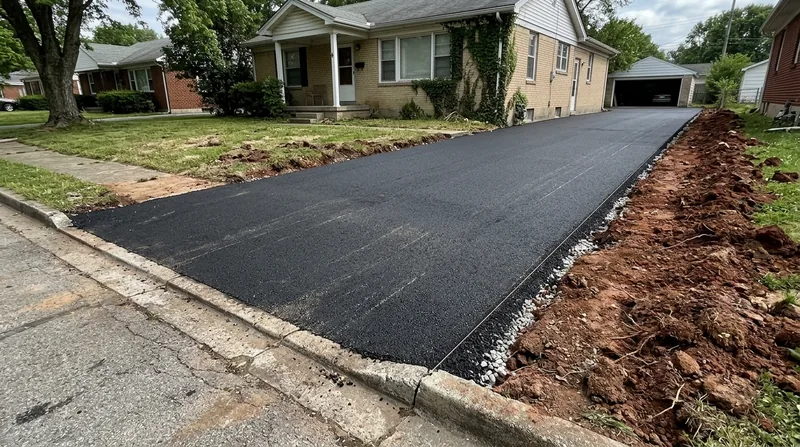




When Louisville's clay base shifts and settles, a simple patch or even a resurfacing won't hold. Driveway replacement in Louisville means removing the old failed surface, rebuilding the aggregate foundation, and laying new hot mix asphalt pitched to shed water. In older neighborhoods from Old Louisville through Germantown and the Highlands, where driveways run as thin side strips beside shotgun houses and Victorians, replacement often makes sense when freeze-thaw cycles and the local clay movement have broken the base beyond repair. In the rolling post-war subdivisions spreading into Jefferson, Bullitt and Oldham counties, the same freeze-thaw damage and moisture movement through poorly compacted base layers drive the need for full replacement. We dig out the failed material, proof-roll the subgrade, rebuild with proper aggregate, and install new asphalt with the crown and pitch that keeps water moving off the surface instead of soaking in. The result is a driveway built to handle Louisville's real winters and wet springs.
Why Full Driveway Replacement Matters in Louisville's Climate
Louisville sits on the flatter river-bottom ground near the Ohio, but the post-war ring and newer subdivisions climb into rolling terrain where driveways pitch with the grade. Underneath lies clay, silt and sand weathered from limestone, shale and sandstone bedrock, and this material holds moisture and moves as it wets and dries. Winters here bring real freeze-thaw cycles that drive water into any open crack and push it back out as a pothole by spring. If the aggregate base has settled, shifted or compacted unevenly, no amount of patching or resurfacing will hold because the foundation itself has failed.
- Extensive alligator cracking across thirty to forty percent or more of the surface signals that the base has lost its structural integrity.
- Repeated pothole formation in the same areas, even after patching, means the subgrade is moving and water is pooling beneath the surface.
- A driveway that has settled or heaved unevenly, with visible dips or high spots, has experienced base failure from moisture movement or poor initial compaction.
- An overlay or resurfacing will fail quickly if it sits on a broken base, wasting money and delaying the real fix.
When the base is gone, replacement is the only solution that holds.
Key info: In Schnitzelburg, Jeffersontown and the Highlands, where many homes were built before modern base-construction standards, we often find that the original driveway was laid directly on clay with minimal aggregate. When that driveway fails, replacement with a proper engineered base is the only permanent fix. Resurfacing looks good for a year or two, then the new asphalt breaks again.
How We Handle Full Driveway Replacement in Louisville
Replacement begins with a site visit to measure, assess the existing base, check drainage and identify any utilities. We then plan the excavation depth, the new aggregate specification, and the drainage pitch. The actual work follows a logical sequence: remove the old asphalt, excavate to the subgrade, proof-roll the base, place and compact new aggregate, and finish with hot mix laid to the proper crown and thickness.
- We measure the driveway and document the existing surface condition, noting failed areas, settlement, and drainage patterns.
- We call Kentucky 811 to locate utilities before any excavation begins, as required by law.
- We remove the old asphalt surface and haul it away, or recycle it if the base is sound.
- We excavate to the proper subgrade depth and inspect for soft spots, settling or poor drainage.
- We place compacted aggregate base, typically four to six inches depending on soil and expected load, and proof-roll it with heavy equipment.
- We lay new hot mix asphalt at the specified thickness, pitched for drainage, and compact it to density.
- We help you navigate any local permitting requirements, which vary by municipality and may involve curb cuts, right-of-way work or stormwater rules.
The entire job, depending on driveway size and base depth, typically takes three to five working days from start to finish.
Example: A homeowner in Prospect had a 400-square-foot driveway with extensive alligator cracking and standing water after rain. The original base was only two inches of poor-quality stone over clay. We removed the old surface, excavated six inches, placed five inches of engineered aggregate, proof-rolled it, and installed new asphalt. Cost was higher than a simple overlay would have been, but the driveway now sheds water properly and will last fifteen to twenty years instead of failing again in two.
For more detail on how we approach asphalt installation from the ground up, see our guide to asphalt driveway paving and installation.
Driveway Replacement Methods: Full Removal vs. Mill and Overlay
| Approach | Description | Best for |
|---|---|---|
| Full Removal and Replacement | Excavate old asphalt and base to subgrade, rebuild aggregate foundation, install new hot mix at design thickness. | Failed or settled base, extensive alligator cracking, poor drainage, uneven settlement or heave. |
| Milling and Overlay | Remove top two to three inches of old asphalt, mill the surface smooth, place new hot mix overlay on the remaining base. | Sound base, surface cracking only, minor settling, good drainage, and at least eight to ten years of base life remaining. |
| Recycled Asphalt Base with New Surface | Crush old asphalt into aggregate, use it as the new base layer, top with new hot mix surface course. | Budget-conscious replacement where the original base is stable but the surface is failed, and compaction can be properly controlled. |
| Full-Depth Reclamation | Pulverize existing asphalt and base in place, mix with new binder, recompact as stabilized base, top with new surface. | Large areas or private roads where hauling is costly, the subgrade is stable, and equipment access is good. |
The choice depends on the condition of the existing base, drainage, and your budget. A site inspection tells us which approach makes sense for your driveway.
Driveway Replacement Cost in Louisville: What to Expect
Full driveway replacement in Louisville starts at around $7 per square foot for a straightforward job with good access and stable subgrade. A typical 400-square-foot driveway runs roughly $2,800 to $3,200 before permits. Larger driveways, complex grading, deeper base requirements, poor subgrade conditions, or difficult access will increase the cost. The price also reflects the local clay and moisture conditions that demand a properly engineered base, not just a quick surface patch.
Several factors move the estimate up or down:
- Base depth and compaction: rolling terrain and clay soils often require five to six inches of aggregate instead of three.
- Subgrade condition: soft spots, poor drainage or old fill material require additional excavation and preparation.
- Driveway size: larger surfaces cost less per square foot due to equipment efficiency and material volume.
- Drainage work: if the driveway slopes toward the house or pooling water is an issue, grading or drainage improvements add to the scope.
- Permits and right-of-way work: curb cuts, apron work or municipal requirements vary by city and add cost if required.
- Existing material disposal: if old asphalt must be hauled away, that is included in the estimate.
We provide a written estimate with tonnage specifications and thickness, so you know exactly what you are paying for and why. For a detailed pricing overview across all our services, visit our pricing page. When you are ready to discuss your specific driveway, call us at (502) 754-0671 for a free estimate.
What to Look for When Hiring a Driveway Replacement Contractor Near Louisville
Driveway paving attracts itinerant crews and door-to-door pitches offering "leftover asphalt from a nearby job" at a steep discount. The single strongest trust signal in this trade is being verifiably local, with a local address, local phone number and local equipment. When you call or visit a contractor, you should be able to verify that they operate from Louisville or the surrounding area and have been in business long enough to stand behind their work. Check that they carry full insurance, ask for references from recent work in your neighborhood, and request a written estimate that specifies asphalt thickness, aggregate depth and tonnage.
A few key steps protect you:
- Verify that the contractor is fully insured and ask to see proof of current coverage before work begins.
- Ask for three recent references from homeowners in Louisville, St. Matthews or Jeffersontown, and call them to discuss their experience.
- Get written estimates from at least two contractors that include thickness, base depth, tonnage and the price for each component.
- Check whether your city requires a driveway permit for the work, and ask the contractor how they help navigate local requirements.
- If you live in an HOA community, verify that driveway replacement meets your architectural standards before signing a contract.
- Be wary of any contractor who asks for a large cash deposit upfront, has out-of-state plates, or offers a price that seems too good to be true.
Kentucky issues no state contractor license for paving, but your city may have local licensing or permitting rules. We recommend verifying what your municipality requires, and checking any contractor's credentials directly with your local building department. When you are ready to move forward, contact us for a free estimate, and we will walk you through the process and answer any questions about permits or HOA requirements in your area.
For more on choosing a contractor and avoiding common paving pitfalls, see our guide to driveway repair in Louisville, which covers how to evaluate when repair, resurfacing or replacement makes the most sense.
Driveway Replacement in Louisville: Pricing Guide
| Service | Price | Details |
|---|---|---|
| Full Driveway Replacement (standard) | Starting at $7/sq ft | Complete removal, new aggregate base, new hot mix surface; varies with base depth and soil conditions |
| Full Driveway Replacement (complex subgrade) | Starting at $8.50/sq ft | Poor drainage, soft subgrade, significant settling, or additional grading required to shed water |
| Replacement with drainage improvements | On estimate | Grading, French drain, or swale work needed to prevent future pooling or foundation damage |
| Permits and right-of-way work | On estimate | Curb cuts, apron work, or municipal requirements vary by city and are quoted separately |
| Travel and site visit | Included | No charge for estimates or site visits within Louisville and surrounding service areas |
| Free written estimate | No obligation | Includes thickness, tonnage, base depth and cost breakdown; response within 24 hours at (502) 754-0671 |
Indicative pricing, the exact cost depends on square footage, finish, and site access. Free personalized estimate within 24h at (502) 754-0671.


